
We are back in Europe for the second time this spring, ready to attack the heart of the European circuit (Grade 1 in Medemblik, Grade 1 in Weymouth, Euro champs in Helsinki). Right now, we are in Medemblik, Holland, as we await the start of the Delta Lloyd Regatta which starts on Tuesday. It is shaping up to be a windy event, as the North Sea is expected to have an active weather pattern for the coming week. This should make for an exciting event and we look forward to stepping up in these challenging conditions and putting some good results together.
Yesterday we had big breeze in our training session and we were able to nail some solid gybes and tacks in the ‘49er red line’ conditions (gusts over 25kts!). In the puffs while sailing off the wind, roaring with boatspeed, we would be heading directly downwind to keep the boat in control – a feat not too common for an asymmetric kite! One of the Aussie boats had a GPS on their boat and they hit 24.8 kts of boat speed out there, an unofficial record for the 49er. We had known it was windy, but it was nice to hear this that it was documented as such! In fact it got too windy to head back out for our afternoon session, as the whole fleet was grounded with gusts well over 30 kts. Forecast for tomorrow, more of the same. Day 1 = moderating.
-Zander
Monday, May 23, 2011


Thursday, May 19, 2011
Europe Round 2!
After a nice break to relax and replenish both mind and body, we are ready to head back to Europe for a second series of events. This time around, we will compete in Northern Europe as the weather warms and compete in the Delta Lloyd Regatta, Sail for Gold and the European Championships. First stop is the Delta Lloyd sailed on a lake just north of Amsterdam. With the North Sea just a few miles away there's an awful good chance of seeing some cold weather. Alot different from our Palma experience!
Keep posted as we will begin training on Saturday with the event beginning on Tuesday!
Sunday, May 1, 2011
Hyeres Wrap Up
Here’s an analysis of Hyeres after a couple days to let it all sink in…
-Our finish in the event was not as strong as we would have liked, but we know the difference between where we are, and where want to be is not far. The fleet is extremely deep, and a testament to that is in the fact that three guys who were in Silver Fleet at Palma were 2nd, 7th and 9th in Gold in Hyeres!
-One of our big goals throughout this first trip to Europe was to work hard on our speed. This, after our Fall and Winter of working hard on boat handling. As this trip wraps up, we can honestly say we have finally found a good setting for <10knots that we are pleased with. The highlight of our event was the speed we had in the races in the final day. We were able to stay in a marginal lane off the line, which was important for the race as our confidence. In >10knots, we feel we are getting faster, but are not there yet- we need to solidify some settings for breeze.
-Something that we generally have been good at but put up a poor show here was starting. I believe we only had 2 good starts out of 15. Certainly not setting us up to a good first beat as the races were in relatively steady gradient limiting the passing lanes. Further, left side of the course was favored 90% of the time so being forced right did not help! I believe this was the biggest contributor to our lack of good roundings at the first windward mark. Developing the hole and a good spot on the line, nor acceleration seems to be the problem. Rather it is our positioning relative to the few boats around us seeing us a little too bow back. This is an issue because as we accelerate, everyone else is as well, and therefore we are not afforded a bow out position. So moving forward to SPA, we will make starting a priority. We must grant ourselves a chance in the race!
-A positive rooting from our poor windward mark rounds were in our ability to grind back some decent finishes. This sparks some confidence in our sailing (but also frustration at ourselves for not have good 1st windward roundings!) Our downwinds throughout the event were definitely a positive. Our tactical decisions, coupled with good speed seemed to help us make gains off the wind.
After a long month of sailing, we are taking a well-needed break for a couple weeks to recharge the battery. This first Europe Trip has been very productive with speed work and practice races as there have been many teams around. Looking forward to SPA and Sail For Gold, our goals will most likely revolve around speed work and our starts. After so much emphasis on boat handling and comfort in the boat over the last few months, we must now focus on the fundamentals of sailboat racing.
Tuesday, April 19, 2011
Hyeres Training

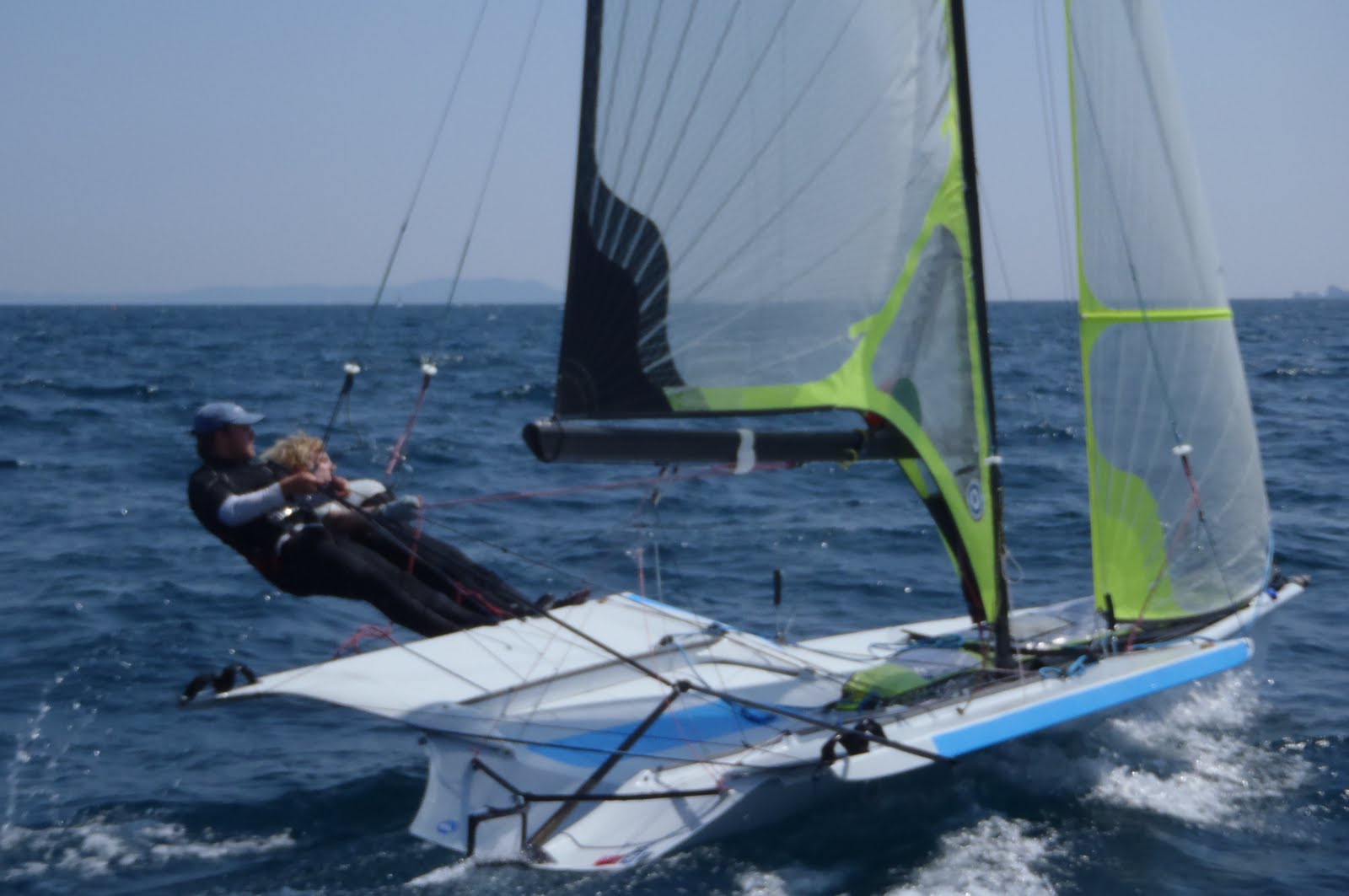
We have had some good training here in Hyeres over the past 6 days, with largely a soft thermal in the afternoon. Typical high pressure has dominated the Mediterranean and given us plenty of time to play with our boat set up in these conditions and to work on starting techniques - to help ensure we are maximizing our acceleration off the line and holding our lane at will. These practices have been extra productive because we have been able to tag along with the US Sailing Team (Erik/Trevor and Alex/Val under coach Dave Hughes) and be involved with animated (video and photos) debriefs from each session. This has been great and is helping us close the boat speed gap with the top of the class.
The third party feedback is great and we hope to work with these guys as much as they want us around! We have been experimenting with different settings, trying to attack all the nuances of world class speed. Part of it is trimming and driving technique, and part of it is rig set up - shroud tensions (caps, primaries, lowers, fore stay), mast bend, jib tack, jib clew, main batten tensions, vang tensions, bridle settings, etc. The list gets complicated fast and you have to try figure out which combinations work together in certain conditions...you can imagine a sailing log for a 49er! Whenever you have good speed against good boats, everything is measured and the conditions are noted. This has helped us start to paint the 'boat speed' picture, but this blatant experimenting seems to be accelerating this procedure. Hopefully we can continue this!
Racing starts on Sunday and the long-term forecast is for a moderate to strong easterly, possibly continuing into the week. An easterly at Hyeres is wavey (like conditions we had last thursday) and is tough for the 49er. This should make for exciting and intense racing!
-Zander
Tuesday, April 12, 2011
Palma Wrap up
Well it has been a few days now and we can reflect back on last week's racing here in Palma.
54th/69 boats (21st country) - a disappointing finish at first glance, especially after all the work we have put in recently, but we remain confident in our sailing and our fundamental view that we can become a competitive team on the world stage by next year. We are eager to continue our training in France and then test ourselves again at the end of the month at the Hyeres French Olympic Week (ISAF World Cup Event #2 in Europe)
There are a number of observations to take note of from the event and the preceding week of training:
- The fleet is deep and close to everyone (save the Greeks, Japanese, AUS and NZL) were in attendance here in the 69 boat fleet (24 nations).
- While boat handling is an ever present priority in the boat, we are now able to play the game and it is not holding us back like it did last year. Yes we did flip on day 1 in the breeze and yes we have many maneuvers to smooth out, but the obstacles are manageable and the priority for our next chapter in the boat is boat speed. We found in this event, when the breeze was steady and there was an evident strategy that needed to be executed to get out front, we were unable to do this because we couldn't hold our lane with other top boats for any substantial length of time. It was extremely frustrating to watch this happen time and time again in our races.
Our speed is good at times and improving, but it is not consistent enough at this level. We need a coach to watch what we are doing in detail and help us develop a clear protocol of boat set up, trim (especially vang tension and mainsheet) and tune (especially low bend and forestay tension) for different conditions and give us confidence in our speed, so we can focus on the tactics and racing. All to often we feel, our lack of speed is distracting our energy away from the racing and all the tactical complexities associated with a 49er race - essentially a sail boat race in fast forward.
- Many competitors and coaches mentioned the level of the fleet has continued to improve (everyone, just like us was busy in the off-season). For us to make strides against this constantly moving bar, we need to accelerate our learning. As mentioned above, we need some coaching and not just random regatta coaches, but someone who can consistently stay with us and help us develop some consistent world class speed. It makes a difference, we have watched peers (similar vintage to us in the boat and similar training regime) make gains relative to us with coaching support. In perfect world, we would have a private coach (or atleast share a coach with a few other training partners), like many of our competitors, but it is just not a financial reality at present. We have not had any spare money for a coach since last July. We have been busy paying for sails, boat transport, air tickets, entry fee’s, insurance, line, spare parts, tools, and the list goes on! We now need to add coaching and the associated costs (coach boat, coach transport) to the same priority level as those. Until we can afford a coach, we will be working with our training partners on rig set up and continue to keep detailed notes on how everything was set and the corresponding results. The other thing we can do now is soak as much information from our friends who are going faster than us.
The level where we are and where we want to be is getting smaller, but these subtle gains can be the hardest to get and that is why we need help now. Both Jesse and I have opinions on certain techniques (trimming, steering) and boat set up (mast low bend, amount of twist, etc) but only with a knowledgeable third party behind us with a video camera can a real consensus be achieved and a truth found,
- Our starting and acceleration technique is coming together. Jesse has watched the top guys on the line and copied their pre-start ‘down speed’ technique and is now able to hold a spot on the line for up to 4 minutes. It is this funny dance of the boats creeping upwind and then backwinding back into the hole. All the while you are looking to windward to see if you can fit in a double tack to enlarge your hole and looking to leeward to protect your hole (usually by barking loud). The acceleration out of the hole is just as important and we usually start it with 6 -8 seconds to go. It requires deft main trim by Zander to power the boat up, without stalling Jesse’s rudder as the boat falls down onto close hauled....All the while we have to delicately run out onto the wing and clip in as well and make sure the boat stays perfectly flat the entire time! What we want to work on now is being able to develop a high mode when you have a marginal lane and be able to hold on until the fleet has shook out the 2nd row. Most of the time we are still starting at an end because it gives you more options if you lose your hole in the final approach. As we get more and more faith in our starting technique we will venture to the middle when our strategy dictates such.
- Tactically, for Hyeres, we are going to try and sail more disciplined on the track. Control the things we can manage (starting, windward mark approaches) and avoid taking as many flyers when we get frustrated with our speed. Yes there is a time and place for gaining extra leverage on the fleet, but the rationale must be able to be defended. It is not the way we usually sail, but if left unchecked this boat can get you into desperate situations that no normal sailboat racer would deem rational.
All in all, it is great that we have another event in two weeks and we can hopefully apply all that we have learned here in such a short time. In the training, we will continue to refine our maneuvers, boat set up and look out for a coach.
If you are interested in helping us with funding for coaching solely, we would be very grateful because coaches at this level do not come cheap and remain close to 50% of our budget through next year.
Tuesday, April 5, 2011
Long Day 2
The second day of Palma was exceptionally long thanks to the wind dying as the gradient gave way to the sea breeze. Further, the Race Committees intent to get 4 races off (we only managed 3) definitely extended the day. Our three races were again filled with a lot of little mistakes at crucial times that saw us squander opportunities.
In the first race, a bad start coupled with the inability to get a lane led us to start way behind and out of phase in the shifty morning breeze. We were unable to get a handling of the breeze and ended with a poor 31. Then as the sea breeze filled in, we were able to start the second race of the day. We had a marginal start near the boat but were able to get a nice lane right. We managed to get going well, and were looking very promising near the top of the beat; however, we didn’t overstand quite enough on the final starboard layline, and got rolled by A LOT of boats. A potential top ten rounding turned into an 18 or 20th at the top. Not good, Incredibly agonizing. On the last upwind of the beat, we got caught too far to the unflavored side of the course and ended up 26th. In the final race, our pre-race plan of port tack approach near the boat worked out really well. After a couple minutes off the line we had half the fleet pointed at our stern; however, on the cross mid way up the leg we found ourselves unable to find a lane back right. We got pushed too far to the left and was mid 20s by the windward mark. On the last upwind, we got going well and were able to pass a few boats, ending up 22nd.
So all in all, a rough day. Frustrating to say the least. We are a couple of mistakes away from having some good races. Our speed is ok, but regardless, if we can sail smart with clean boat handling we should be able to put up some good scores. Keep posted for tomorrows races!
Monday, April 4, 2011
Palma Day 1

Photo is us (in the center of the shot) approaching the windward mark in the top 10 in race 2
Racing was tough today in the puffy, offshore conditions. 20th and 29th, 51st/69 boats overall. Pretty much all the players in the world are racing this ISAF grade 1 event in Palma de Mallorca. 24 countries from all over the world.
We had two good first windward mark roundings, rounding 11th and 8th, in the two races respectively - Up with all the top boats and in unfamiliar territory to date! It was nice to do that in both races, and we know we are few boat handling mistakes away from nailing two top 15 finishes. That would have us with our training partner, currently the top American boat in the event.
We were happy with our tune, as we continue to learn more and more about our highly responsive rig. In the big breeze, we had some smooth gybes, tacks, one very nice gybe-set and some good hoists. The one real boat handling issue was our douses at the leeward mark (also the windiest part of the course), that is when we flipped in the second race on the second leeward mark rounding. It was heart breaking because we were in 14th place, over halfway through a grueling race and we had a nice little gap behind us. We righted the boat quickly and got back to racing and were still able to beat a handful of boats, but the damage had already been done...that capsize cost us 20 places overall! But this is all early days and we know we can put it together. 4 races tomorrow, a long day, and we know tomorrow will be when the results will shake out. So we live to fight another day at our first event in Europe of 2011 and have hopes of moving up through this internationally stacked fleet.
-Zander
Subscribe to:
Posts (Atom)
